

Acquiring a copyright on a book translation


Authors, publishers, agencies, and individuals — different clients with their own needs and goals turn to MK:translations for book translations. But regardless, every discussion of the terms of cooperation still ends with the question of the author’s translation right.
This is not surprising, as copyright law is one of the most important aspects of intellectual property protection. When translating a book, copyright plays a key role because it protects both the original work and all its versions in other languages.
In the article, we will tell about the basic principles of translation copyright and legislative regulation of these issues.
Does one need a translator-publisher contract
Copyright law protects literary works and guarantees authors exclusive rights to use and distribute their works. It also covers book translations and the subsequent distribution of adapted language versions. However, according to Ukrainian law, a translator owns the translation copyright if it is the result of their creative activity. Such a translation is called a derivative work, and can only be used with the permission of the new author (i.e., the translator). However, there are exceptions provided by the Law of Ukraine “On Copyright and Related Rights”, for example, when a manuscript becomes public domain 70 years after the death of the author.
The proprietary translator’s copyright (there is also personal non-proprietary copyright such as to name and pseudonym) can be transferred to any person, author, publisher, or simply grant permission (license) to use this translation.
As an example, let’s consider a fragment of a template of the translator-publisher contract, which demonstrates the transfer of copyright on a book translation to the customer.
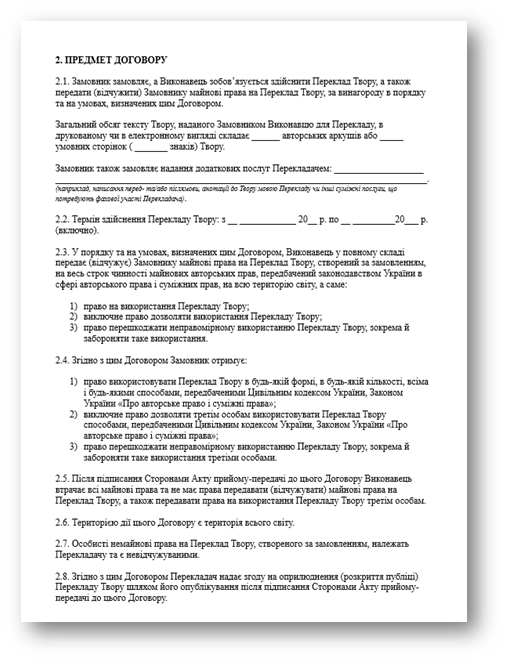
Under this contract, the translator, having received his fee for the work performed, loses all rights to use his translation: reprinting the book independently, transferring the text to another publisher, granting the rights to screen or theatrical production, etc.
The second template presents a contract for the transfer of translation copyright under a license. It is issued to a specific publisher for a specific period of time, is valid for a specific territory, and excludes the possibility of the translator issuing identical licenses to other persons.
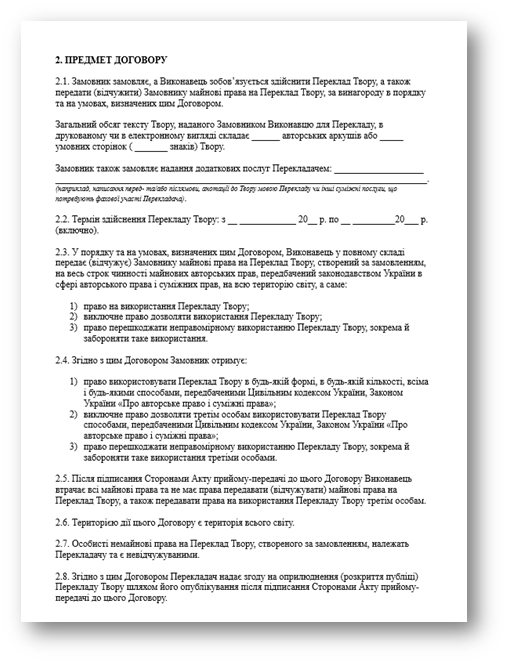
These contracts are concluded when the translator and the publisher do not have an ongoing employment relationship and their cooperation is not governed by other legal documents.
Although translation is a derivative work that is also protected by copyright, the translator cannot act as they wish: to freely translate any book they like and dispose of that translation as they please. In order to do this, one must obtain the author’s consent to translation by concluding a contract that clearly defines the terms of use of the work and the amount of remuneration for the right holder.
Therefore, after obtaining the author’s consent, the translator may use and distribute the translated text, but only if it does not violate the rights of the original author.
Each country has its own statutory provisions for copyright protection. However, most states have acceded to the Berne Convention, which guarantees international copyright protection. One of its basic principles is that works protected in one member country have the same protection in other member countries.
Read also: Why literary translation cannot be an exact copy of the original
Five steps to acquire the copyright on a book translation
Acquiring a copyright on a book translation is an important and often complex process that requires careful attention and legal preparation. Let’s consider each of its stages.
1. Identifying the rights holder
The first step is to identify the copyright holder of the text. Most often it is the author of the work or the publisher who published the book with the original work. To do this, you can:
- Check the information on the book itself;
- Check directly with the publisher who published the book;
- Contact the author or their literary agent.
2. Translation request
Whether in an email or a formal request by other means, it is important to make clear your intention to translate the book, to introduce yourself, your experience, and the intended publisher of the translation, if you have already received their prior approval at that point.
3. Negotiations and contract conclusion
If you have obtained the author’s consent to the translation, you need to settle this legally. The main points to be stipulated and included in the contract:
- Whether the contract covers only translation or also distribution of the translated text;
- What territory the translation is authorized to be used on;
- For what period the translation copyright is granted;
- The amount and type of remuneration – fixed amount or royalty;
- Deadlines for performing the translation;
- Terms of distribution and marketing support for the translation.
It is important that the contract be drafted or at least reviewed by a lawyer who specializes in copyright and intellectual property. This will help you avoid unpleasant legal problems in the future.
4. Registration of rights
It is not difficult to register a translator’s copyright in Ukraine. The procedure is regulated by the Berne Convention, the Civil Code of Ukraine and the Law of Ukraine “On Copyright and Related Rights”. Registration takes an average of two to three months.
5. Performing the translation
Once the translator’s copyright is obtained, the work of translating the book can begin. It is important to comply with all the terms of the contract and communicate with the author or other rights holder throughout the translation process.
The most common copyright violations in book translation
- Unauthorized translation
A translator chooses a popular book and adapts it into a new language version without obtaining the author’s consent to translation. They then publish the translation online or give it to a publisher, thereby violating copyright.
- Unauthorized distribution of translation
The translator obtains the author’s consent to translation of a book for personal use or limited distribution (e.g., only within an educational institution). However, they decide to publish their work online or sell the translated book on Amazon, violating the terms of the contract.
- Plagiarism
Another type of translator’s copyright infringement is using someone else’s work to publish under one’s own name without identifying the real author of the translation.
All of these violations can have serious legal consequences, including fines and lawsuits. It is therefore important to comply with all legal requirements and the terms of the contract with the right holder.
Conclusion
Acquiring copyright on a book translation is a multilayered process that requires care and legal preparation. Following the necessary procedures not only protects the interests of all parties, but also contributes to the creation of quality translations that enrich cultural heritage and make literature accessible to a wide audience.
MK:translations professionals have been translating various types of books for over 10 years: from textbooks and manuals to non-fiction and poetry collections, so they know everything about translation copyright. For a detailed consultation on the service or to order a literary translation, please contact us by phone or messengers listed on the website.
Read also: What is slang and why is it difficult to translate


Haven’t found
what you were looking for?
Don’t leave yet!
Just click on the button below, and we will get back to you to consult on all services of the company.
 Contact us
