

Game localization for Southeast Asia: key facts about the local market and audience


Usually, people associate the Asian video game market primarily with China, given that it has the largest population in the world, and a significant share of this population is active gamers (according to various sources, more than 700 million). Lately, however, analysts have been paying more and more attention to the neighboring region of Southeast Asia. We at MK:translations understand this interest. Here is why.
Read also: Getting started with exports without losing opportunities due to lack of experience
Market size and prospects
The region consists of eleven countries of the Indochina Peninsula, the Malay Archipelago and neighboring islands. Due to its proximity to other popular markets, as well as the diversity of the local audience, it has become a prime platform for soft launches and beta tests that allow developers to understand the potential user response to the product in the global Asian market.
Experts single out a separate segment in the region, SEA-6, consisting of Indonesia, Malaysia, the Philippines, Singapore, Thailand, and Vietnam. According to Niko Partners, by 2027, these six countries will experience a drastic increase in gaming revenues, mainly due to mobile devices, which contribute 66.4% of cash flow.
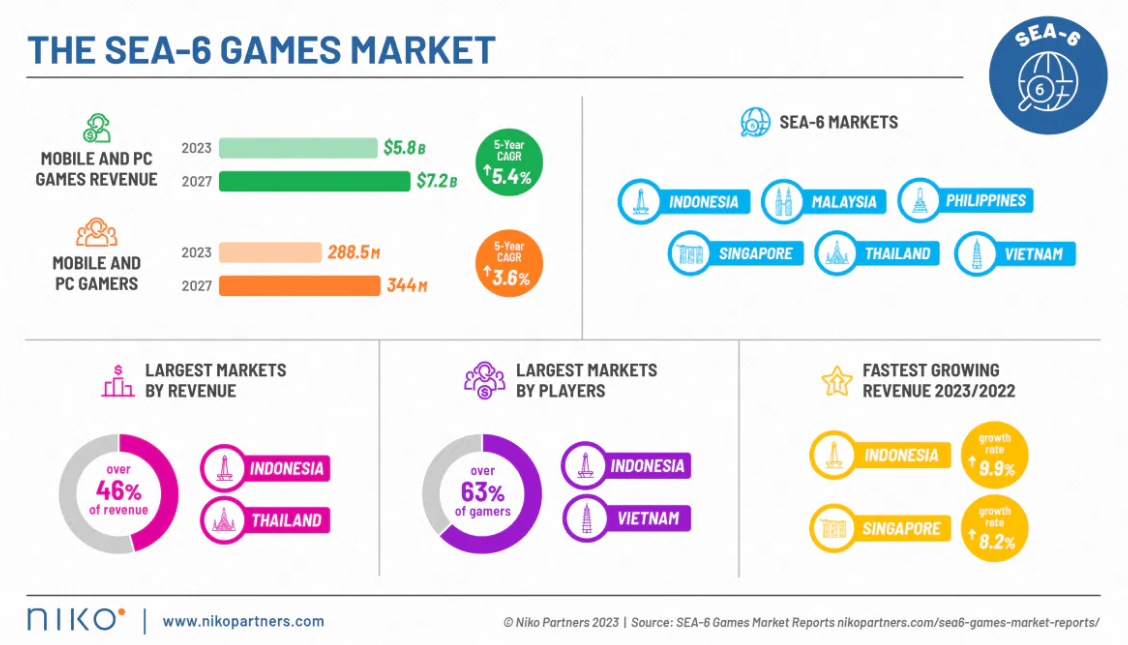
Southeast Asia is now the fastest growing mobile gaming market in the world. This is confirmed by Statista’s forecasts.
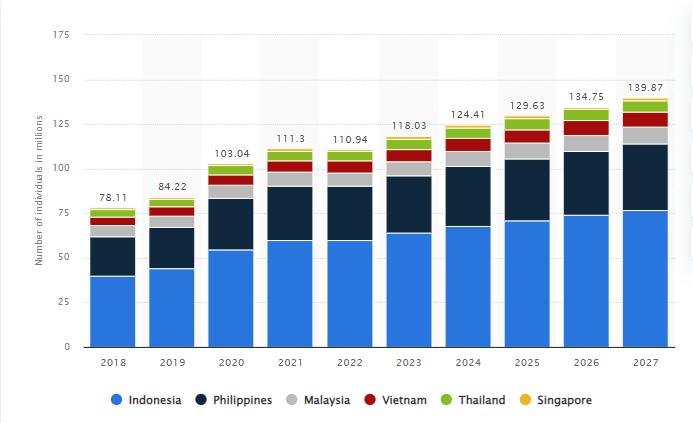
The number of mobile gamers in Southeast Asia from 2018 to 2027 by country (in millions of people). Source: https://www.statista.com/
SEA’s gaming market is estimated at $14.80 billion and is predicted to reach $14.93 billion by 2029 (see infographic).
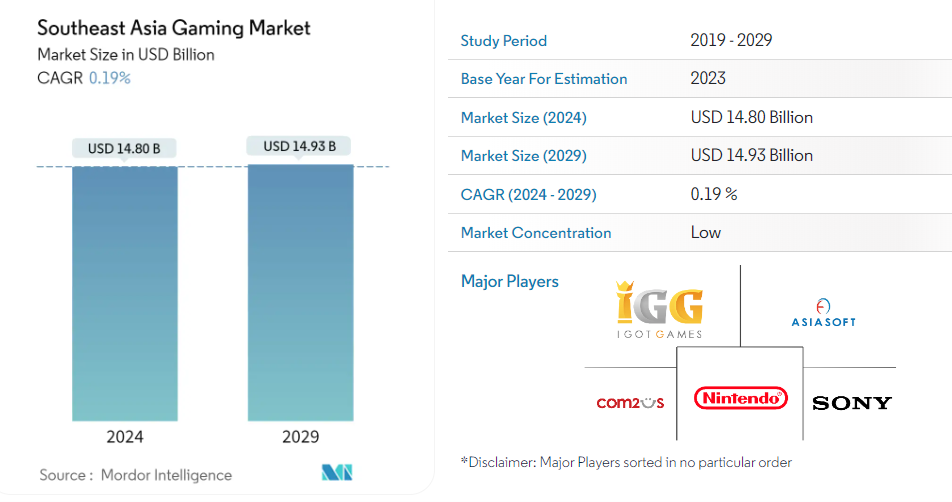
Such enormous development potential is due to the growing popularity of esports, included in the 19th Asian Games in Hangzhou, and investments in Internet infrastructure and 5G development. Besides, government support for the gaming industry in Southeast Asia has increased in recent years, as various initiatives, funding programs, and legislative changes have created a favorable environment for the industry’s growth. Therefore, global gaming companies have been opening new offices here, holding large-scale events, and actively interacting with the local gaming community.
15 facts about the audience and cultural differences that will prove useful when localizing games for Southeast Asia
- A survey conducted by Google shows that more than 82% of the urban Internet users in Southeast Asia are gamers, and mobile games outsell PC and console games by a wide margin.
- A significant number of players are in the 18-34 age group, which is approximately 70% of the total number of gamers.
- However, more than 55% of mobile players are over 55 years old, and only 8% are teenagers, due to the popularity of hyper-casual and casual games that do not require special skills.
- A Google study found that one in three smartphone owners in Southeast Asia plays mobile games at least once a week.
- According to a report by Niko Partners, 37% of gamers in Asia are women, and this number is projected to grow by 11% per year, almost twice as fast as among male gamers.
- Women account for 23.5% of all gaming revenue in the region, and this figure is expected to almost double over the next few years.
- Most women in Asia simply play for pleasure, but there is a growing number of Generation Z female gamers who participate in competitions and eSports.
- Puzzle games are the most popular genre in Asia among female gamers (39.2%), followed by MOBAs (26.9%) and Battle Royale (20.3%).
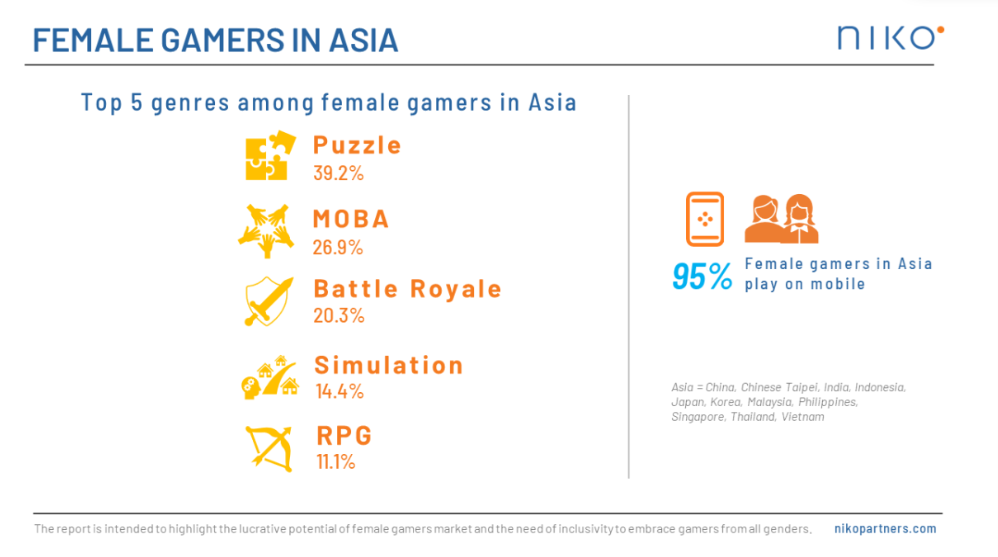
- As the number of female gamers grows, so does their dissatisfaction with game characters: the depiction of female characters or the absence of female avatars at all, which is seen as discrimination in the gaming space.
- The region has a cult of the family and traditional family values. Suspicion of homosexuality is grounds for social isolation (but not persecution).
- The local population is prone to collectivism, and social harmony and group interests are often placed above personal ones. Cooperation and mutual support are important for Asians.
- Southeast Asia is characterized by great religious diversity:
- Islam dominates in Indonesia, Malaysia and Brunei;
- Buddhism is the main religion in Thailand and Vietnam;
- The majority of the population of Myanmar, Cambodia, and Laos profess Theravada Buddhism;
- Christianity is widespread in the Philippines, and 97% of the population of East Timor is Catholic;
- The main religions of Singapore are Buddhism, Christianity and Islam.
- Nevertheless, in many countries in the region, people believe in spirits, talismans, and amulets to bring good luck or protect them from evil.
- GWI research has shown that 16% of consumers typically learn about new brands and products through advertisements they see in video or mobile games. This figure is highest in the Philippines (24%), Thailand (20%), and Malaysia (16%).
- For mobile payments, local users typically go for apps such as GoPay, OVO (Indonesia), GrabPay (Malaysia, Singapore), and TrueMoney (Thailand).
Read also: How global brands use transcreation in marketing campaigns: McDonald’s case
Languages spoken by gamers in SEA-6 countries
Each country in the region has its unique languages and dialects. Indonesia alone has about 400 languages, and the Philippines has more than 170. Local languages have a lot of Western borrowings, which is the result of past colonizations. For example, Thai contains German and Spanish words, although it is generally based on ancient languages such as Sanskrit and Pula. The Malay language spoken in Malaysia has been influenced by Arabic, Sanskrit, Portuguese, Dutch, and Chinese.
- Indonesia
The official language of the country: Bahasa Indonesia. It is used at the state level, in the media, the judiciary, and in education. However, in everyday life, the Indonesian language, which has not evolved too far from Malay, is hardly spoken because it is considered inflexible and “poor.” Instead, everyone uses their native dialect, sometimes in its pure form and sometimes mixed with Bahasa Indonesia. Even two neighboring towns 100 kilometers apart can have separate languages.
- Thailand
The country has 74 languages, including several dialects of Thai, the official language. More than 80% of the population speaks Siamese Thai, which has been heavily influenced by Lao due to its proximity to Laos. The Bangkok dialect is also widely spoken.
- Vietnam
The official language is Vietnamese, spoken by more than 75 million people. It has three dialects: northern (spoken in Hanoi and its environs), central (Hue), and southern (Ho Chi Minh City). In addition, Khmer, Lao, and Chinese (Cantonese and Mandarin dialects) are also spoken.
- The Philippines
There are two official languages in the Philippines, Filipino and English, which is used mainly at the state level and in business. Interestingly, the Indonesian language uses the Latin alphabet due to the influence of Spanish and American colonizers. In total, more than 170 languages are spoken on the islands, with Spanish, Chinese, and other indigenous languages widely spoken.
- Malaysia
Malay has the status of an official language. Manglish (adapted British English used in business and education), Chinese (Cantonese), and Tamil are also widely spoken. In total, more than 130 languages are spoken here.
- Singapore
The national language is Malay (due to the special status of the Malays as the indigenous population of Singapore): it is used in the national anthem and military commands. At the same time, four languages have the status of official languages: English, Malay, Chinese (Mandarin), and Tamil. Singlish (a local variant of English) is used at the state level, in business circles, and the educational process.
Key findings
As a dynamic market with a huge audience, Southeast Asia offers great opportunities for international gaming companies. However, cultural diversity complicates the process of conquest, because there is only one market, but there are many audiences, and each is unique with its characteristics.
To create the most attractive product for local gamers, MK:translations experts recommend that developers and publishers use high-quality game localization for Southeast Asia. Localization of games will not only contribute to a better understanding and perception of the game but also increase its competitiveness in local markets. After all, every detail can be crucial to attracting and retaining players.
Read also: How localization is changing the modern GameDev market


Haven’t found
what you were looking for?
Don’t leave yet!
Just click on the button below, and we will get back to you to consult on all services of the company.
 Contact us
