

How global brands use transcreation in marketing campaigns: McDonald’s case


Global brand marketers use a variety of tools and processes to reach new markets, depending on whether they want to attract new foreign audiences, increase brand awareness and customer loyalty, or increase sales.
There’s no better way to connect with your audience than by using their native language. However, it is not always possible to reach the hearts of foreign consumers and make them open their wallets with the help of basic translation: this requires cultural adaptation. This is why localization services are in great demand among our customers, and the list of language pairs for such requests is constantly expanding.
If marketing or advertising content requires cultural adaptation, MK:translations turns to transcreation.
Read also: How to localize a marketing campaign for your customers without draining the budget
What is transcreation
Transcreation is gaining more and more recognition in the translation industry and goes beyond simple translation.
This term is a combination of two English words — “translation” and “creation”, and can be translated as creative translation, a kind of mix of translation and copywriting. Creative translation is most often used to adapt product and brand names, advertising materials (slogans, presentations, or video scripts), and movie titles. Its main task is to transform the original content into one that is more relevant to the target market, while maintaining the message’s content, purpose, and emotional coloring.
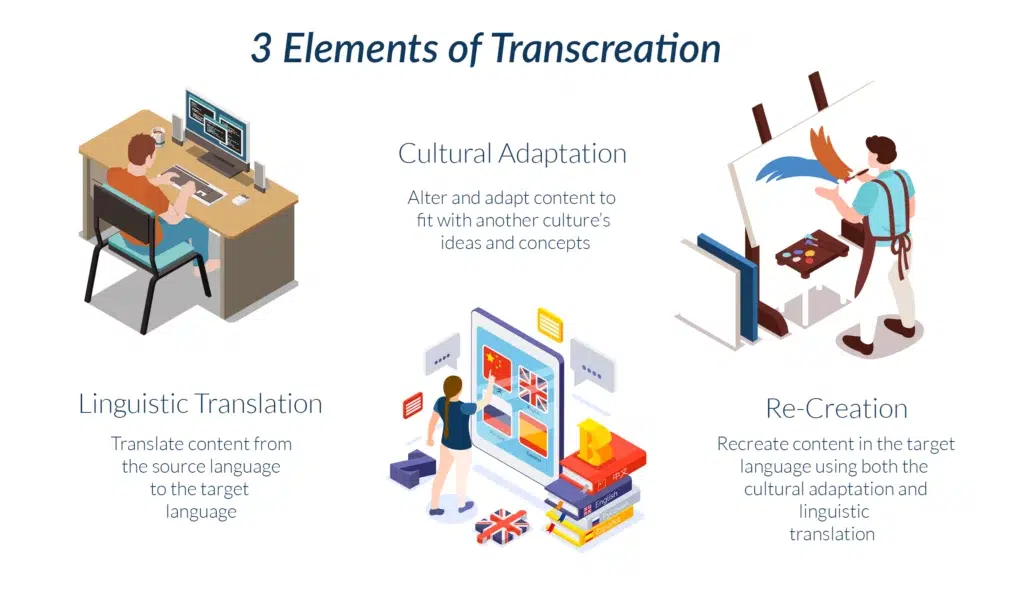
High-quality transcreation is only possible through close cooperation between the client and the contractors, as they must have a clear understanding of each campaign’s goals, brand values, and its target audience.
Localization and transcreation — what’s the difference?
The concept of transcreation lies in combining translation and marketing functions; it is meant to make the audience feel like the message was created specifically for them. In the words of the German translator Katharina Eddins, “consumers should not judge the quality of transcreation because they should not even realize that there has been any transcreation done in the first place.”
Transcreation differs from localization in that it doesn’t just adapt content, it transforms it. In some cases, it may even be necessary to completely change the message, its format and style, but only if the point and purpose are preserved.
Cases in which transcreation is most often used
Let’s start from the other side. In order to accurately reproduce the content of the original source in the target language, translation will come in handy. This applies to scientific articles, educational materials, medical, legal, technical texts, etc.
Localization is used to adapt a website or a game to the cultural peculiarities and habits of foreign users.
However, if you wish to communicate something creative, something that conveys an idea, such as Internet banners, advertising slogans, videos, or emails, you won’t be able to do it without transcreation.
Businesses can use transcreation to:
- Communicate with the target audience in a more informative way;
- Improve engagement, conversion rates, sales, and ROI;
- Demonstrate expertise and experience;
- Expand their market share.
Creative translation takes more time and resources than literal translation of a text, as it requires working with native speakers, advertisers, marketers, and copywriters who create customized messages for each audience and geographic region. But the experience of MK:translations clients proves that these efforts always pay off.
The following industries can benefit most from transcreation:
- Advertising and marketing (product and brand names, advertising slogans and scripts, and other marketing materials);
- GameDev;
- Literature, film, and television (titles of publications, films, and television products, humor, slang, idioms, and common expressions, cultural references).
Read also: What is slang and why it is difficult to translate
Transcreation in McDonald’s advertising campaigns
As mentioned above, transcreation is often used in advertising to adapt slogans and other marketing materials, as it helps to resonate with a specific cultural audience. It’s not just about translating words, but about capturing and preserving the essence, tone, and emotional influence of the original message, and effectively communicating it to different geographic groups of consumers. This is because each market has its own effective tools and ways for brands to interact with the local audience, and often even the slightest shift in words, colors, or design has a big impact on the campaign’s success.
One of the classic examples of creative translation in advertising is the adaptation of the well-known McDonald’s slogan “I’m Lovin’ It”.
- In Spain, it became “Me encanta,” which in English would be “I really like it.” The fact is that Spanish-speaking consumers consider “love” to be a very strong verb, so it would be inappropriate to use it in a slogan given this cultural nuance.
- In France, “I’m Lovin’ It” was replaced with ‘C’est tout ce que j’aime’, i.e. ‘That’s All I Love’ in English translation. It’s the way the French speak about things they like. And for French-speaking residents of Quebec, Canada, the slogan was translated closer to the original – “This is what I love.”
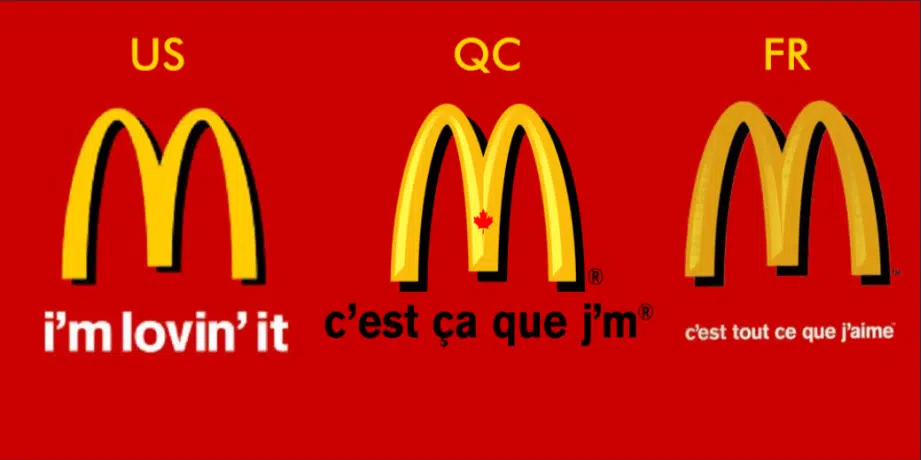
As you can see, a slogan can sound different even within the same language, depending on the audience and region.
- In China, a direct translation of “I’m Lovin’ It” would not have resonated with the local audience due to cultural and linguistic differences. Instead, McDonald’s went with the slogan “我就喜欢,” which translates roughly to “I just like it.” This option still retains the positive tone of the original, while being culturally and linguistically appropriate for the Chinese audience.
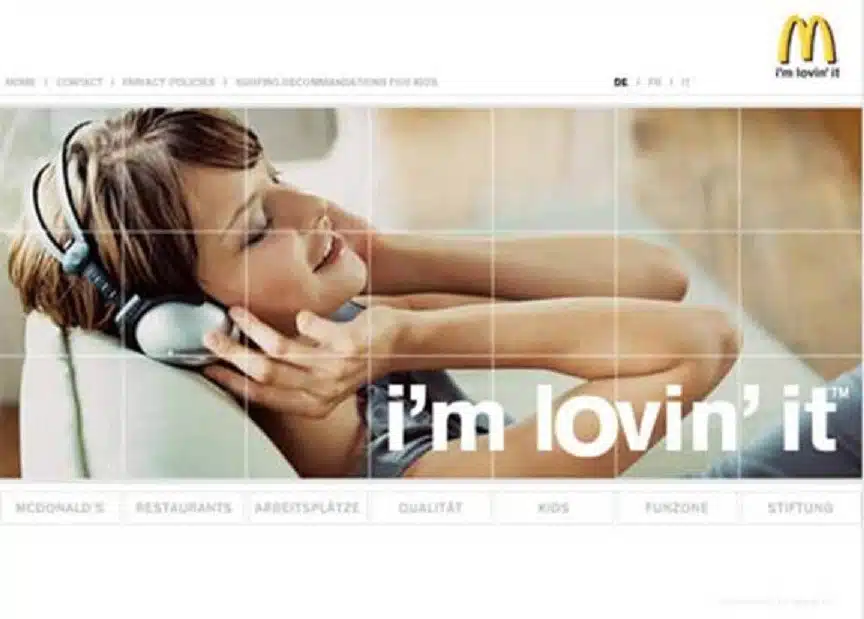
For some markets, the slogan was left unchanged, but its graphic representation was adapted. In Switzerland, for example, “I’m Lovin’ It” was combined with an image of a relaxed girl listening to music in her headphones alone. It can be explained by the cultural peculiarity of the Swiss: like most Europeans, they are individualists.
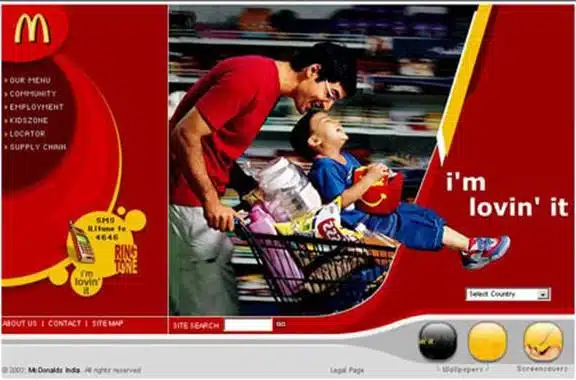
For the Indian audience, they used a picture of a happy family, enjoying each other’s company while going to the supermarket. There is a cult of family and family values in India, so these associations are likely to evoke positive emotions among local consumers.
Conclusion
High-quality transcreation naturally creates the right tone and emotion in messages for different cultures, regions, and languages. To achieve this, transcreation should ideally be an integral part of the production process.
McDonald’s hires international teams with knowledge of the market and local peculiarities to develop products and content, which ensures that marketing solutions are relevant and effective for each specific audience. Learn from global brands: study your customers, adapt your products and content, and MK:translations specialists will help you with this.
Read also: How LQA will protect you from the consequences of a bad translation


Haven’t found
what you were looking for?
Don’t leave yet!
Just click on the button below, and we will get back to you to consult on all services of the company.
 Contact us
